Headlight Restoration: How It Works and Why It Matters for Night Driving
The short answer
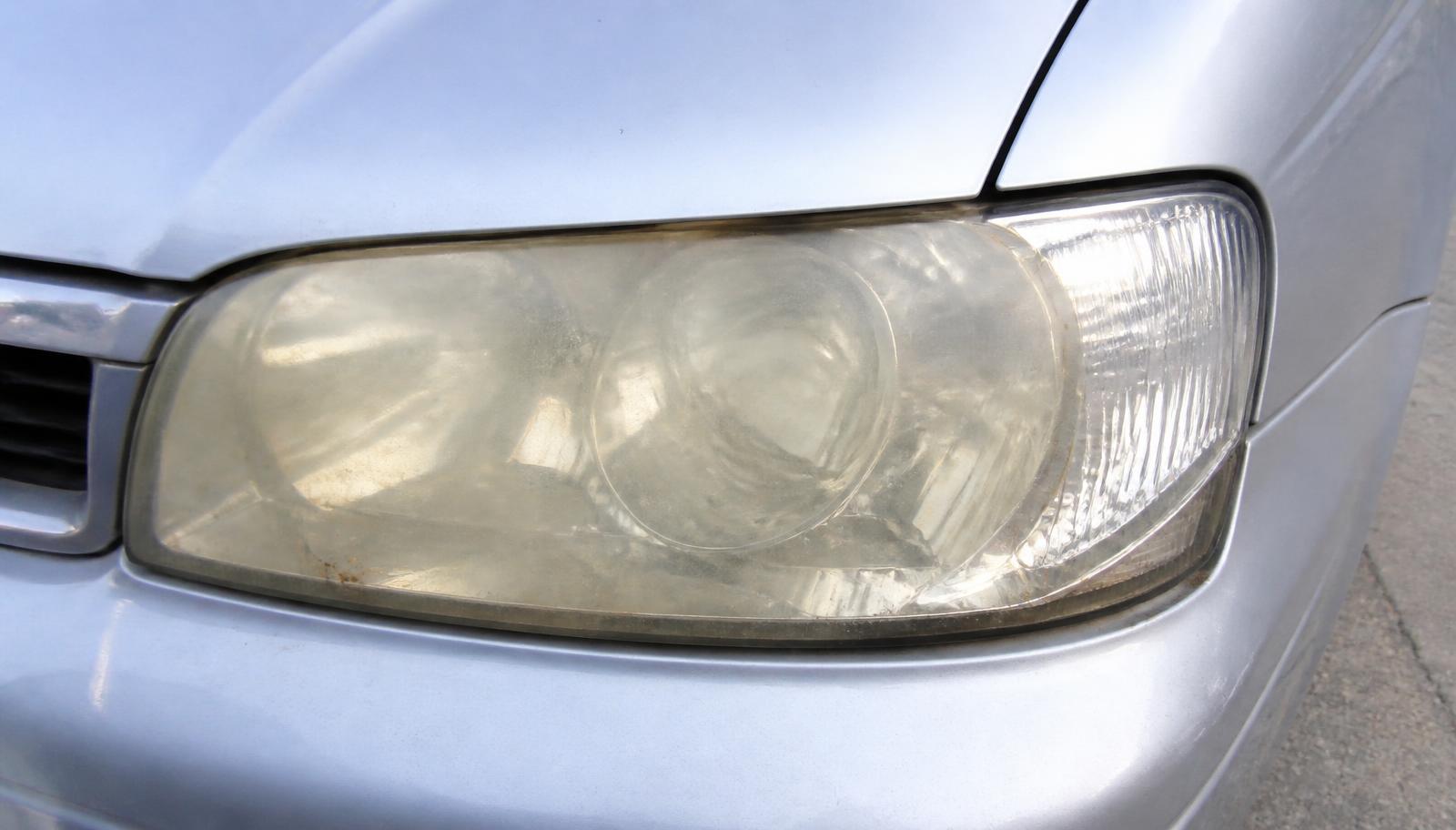
Headlights turn yellow because UV light degrades the protective coating on the polycarbonate lens, allowing the plastic underneath to oxidize. Professional restoration wet-sands the damaged layer away in progressive grits, polishes the lens back to clarity, and applies a new UV-resistant sealant. Cost at Vantage Auto Pros is $200 for a pair.
Here's a test. Park facing a wall after dark and turn on your low beams. If the light pattern looks soft, yellowish, and scattered rather than bright with a defined cutoff line, your headlights aren't dim because of the bulbs. They're dim because of the plastic in front of them.
Hazy headlights are one of those problems that develop so gradually you stop noticing. Your eyes adapt year over year, and then you drive a friend's newer car at night and realize how much you've been missing.
Why headlights go bad
Until the mid-1980s, headlights were glass. Glass doesn't yellow — it just breaks, which is exactly why the industry moved on. Modern lenses are polycarbonate: lighter, far more impact-resistant, and moldable into the complex shapes designers want.
The trade-off is that polycarbonate degrades under ultraviolet light. To compensate, manufacturers apply a hard UV-protective coating to the outer surface at the factory.
That coating is a consumable. It has a service life, typically five to ten years depending on climate and exposure, and it wears out from:
- UV exposure. The primary driver. Sunlight breaks down the coating molecule by molecule.
- Heat cycling. Headlights get hot from the bulb, cold overnight. Expansion and contraction stresses the coating.
- Road chemistry. Salt, brine, sand, and washer fluid abrade and chemically attack the surface. Minnesota is hard on headlights for the same reason it's hard on rocker panels.
- Automatic car washes. Brushes and harsh detergents accelerate wear.
Once the coating fails, raw polycarbonate is exposed. It oxidizes, develops microscopic surface pitting, and turns yellow. The pitting is what scatters light — instead of a focused beam, you get diffuse glow.
The safety math
This is where it stops being cosmetic.
The AAA Foundation's headlight research tested deteriorated headlights against new OEM replacements and found that badly clouded lenses can deliver as little as 20 percent of the light output of new units. Restoration recovered a large share of that output.
What that means on a dark county road: your effective visibility distance shrinks substantially, at exactly the speeds where you need the most reaction time. In Minnesota, where full darkness arrives before 5 p.m. for months and roads are frequently wet or snow-covered, that's not an abstract concern.
Scattered light causes a second problem — glare for oncoming drivers. A pitted lens throws light in directions the reflector never intended, above the designed cutoff line and into other people's eyes.
There's also a compliance angle. Minnesota requires functioning headlights that project adequately, and severely deteriorated lenses can draw an equipment citation. The Minnesota Department of Public Safety publishes the state's vehicle equipment requirements.
What restoration actually involves
The core idea is simple: the damage lives in a thin surface layer of the lens. Remove that layer, restore optical clarity to the fresh plastic underneath, and protect it again.
1. Clean and mask. The lens is washed and the surrounding paint and trim are taped off. Sanding a lens without masking means sanding your fender.
2. Wet sanding, progressive grits. This is the actual restoration. Starting with a coarse enough grit to cut through the oxidation — often 800 — then stepping through 1000, 1500, 2000, and finer. Each pass removes the scratch pattern left by the previous one. Skipping grits leaves deep scratches that polishing can't fix, which is why DIY kits with one sandpaper grade produce mediocre results.
The lens looks completely frosted at this stage. That's correct and expected.
3. Machine polishing. A compound and polishing pad refine the fine sanding marks into optical clarity. This is where the lens goes from frosted white back to transparent.
4. Surface preparation. The lens is cleaned of all polishing oils. Sealant won't bond to residue.
5. UV sealant application. The step that decides how long the work lasts. Bare polished polycarbonate with no protection will yellow again within months — sometimes faster than before, because the factory hard coat is now completely gone. A quality UV-resistant sealant restores the protective barrier.
Done properly, this is a 60- to 90-minute job for a pair of headlights.
Why DIY kits underperform
We're not going to tell you a store kit never works. On mild haze, a decent kit produces a real improvement. But the failure modes are consistent:
One grit isn't enough. Heavy oxidation needs aggressive cutting followed by several refinement steps. Kits usually include two grades.
Hand sanding is uneven. Pressure varies, and the result is a lens that's clear in the middle and hazy at the edges.
The protection is weak. The wipe-on sealant in most kits lasts a few months. Then you're re-sanding annually, and each cycle removes more lens material.
Toothpaste and bug spray don't work. Toothpaste is a mild abrasive that lightly polishes and removes essentially no oxidation. Bug spray contains solvents that temporarily dissolve the surface — it looks clear for a day, then hazes worse because you've chemically damaged the plastic. Please don't.
Restoration vs. replacement
Restoration works when the damage is on the outer surface — yellowing, haze, fine pitting, light scratching. That's the vast majority of cases.
Replacement is the answer when:
- The lens is cracked
- Moisture is getting inside the housing (an interior seal failure — polishing the outside does nothing)
- The reflector coating inside is peeling or burned
- The oxidation has gone all the way through the lens material
Cost difference is significant. Restoration on a pair runs $200 with us. Replacement housings for a common sedan run a few hundred dollars for aftermarket units and often over a thousand for OEM on newer vehicles with integrated LED assemblies — before labor and aiming.
How long it lasts
Realistically, one to three years, driven by:
- Sealant quality. Professional-grade UV sealants substantially outlast consumer wipe-ons.
- Where you park. Garage-kept vehicles hold clarity dramatically longer. A car parked facing south in an uncovered lot all summer is the hardest case.
- Washing habits. Frequent brush washes wear the sealant faster.
- Climate. Minnesota's freeze-thaw cycling and heavy winter road chemistry are tougher on sealant than a mild climate.
You can extend it: wash headlights when you wash the car, avoid harsh cleaners on the lens, and park in shade or a garage where possible.
Should you do it?
Straightforward test. On a sunny day, look at your headlights from three feet away.
- Crystal clear: nothing to do. Keep them clean.
- Slight cloudiness, no yellow: you're early. A light polish and fresh sealant now prevents real oxidation later.
- Visibly yellow or hazy: restore them. You're losing measurable light output.
- Brown, heavily pitted, or flaking: restoration will still make a large difference, though expect to land at very good rather than showroom.
If you're selling the vehicle, headlights are one of the highest-impact items on the list. Hazy lenses read as "neglected" to every buyer who walks up to the front of the car, and they show in listing photos. See how often you should detail your car for where this fits in an overall maintenance plan.
Restoration and the rest of the front end
Headlights rarely deteriorate alone. If the lenses are oxidized, the same UV and road chemistry has usually been working on everything around them, and that's worth knowing before you decide what to fix.
Tail lights and turn signals. They're the same polycarbonate with the same coating. Red and amber lenses hide oxidation better than clear headlights, so most people never notice they've gone dull. They restore with the same process.
Fog light lenses. Mounted low, so they take the worst of the sand and salt spray. They pit rather than yellow.
Plastic trim and mirror caps. Unpainted black plastic fades to a chalky gray under the same UV load. Cleaning and dressing brings the color back, and it's part of our exterior work.
The paint above the headlight. The leading edge of the hood and bumper takes the most rock chips. While the front end is being worked on, it's the natural moment to check for paint breaks and touch them up before Minnesota winter gets into them.
A word on bulbs
If your headlights are clear and you still feel like you can't see, the bulbs may genuinely be the problem. Halogen bulbs dim gradually over their life — a bulb at 80 percent of its rated hours puts out noticeably less light than a new one, even though it looks like it's working fine. Replacing both bulbs in a pair is standard practice, since the second one is usually near the end of its life too.
What we'd caution against is dropping high-output LED bulbs into a housing designed for halogen. The reflector geometry is engineered around the exact position and shape of a halogen filament. Change the light source and the beam pattern scatters, which blinds oncoming drivers without meaningfully improving what you can see. If you want brighter, start with clear lenses and fresh correct-spec bulbs.
Aiming
Restored lenses occasionally reveal that headlights were misaimed all along — the haze was scattering enough light that nobody noticed the beam pointing at the treetops. Aim is adjustable on most vehicles with a screw on the housing, and any shop can set it properly. It costs almost nothing and makes a large difference in usable road illumination.
Our service
Headlight restoration at Vantage Auto Pros is $200 for a pair, done at your location, typically in about an hour. Multi-stage wet sanding, machine polishing, and a UV-resistant sealant — not a wipe-on product.
It's also the one service we allow you to combine with a detail package, since it pairs naturally with an exterior detail or a full detail. Everything gets reset at once and the whole front end of the car looks years newer.
Serving Minneapolis, St. Paul, and the surrounding suburbs. Book headlight restoration and see what your low beams were supposed to look like.
Frequently asked questions
Why do headlights turn yellow?
Modern headlight lenses are polycarbonate with a factory UV-protective hard coat. Sunlight, heat, and road chemicals break that coat down over roughly five to ten years, and the exposed plastic oxidizes and yellows.
How much light do foggy headlights lose?
Independent testing by AAA found that badly deteriorated headlights can produce as little as 20 percent of the light output of new headlights, which meaningfully shortens how far ahead you can see at night.
How long does headlight restoration last?
One to three years depending on the sealant used and how the vehicle is stored. Garage-kept vehicles hold clarity considerably longer than vehicles parked outside facing south all summer.
Does toothpaste really restore headlights?
It provides a mild abrasive polish that can slightly improve very light haze, but it removes no meaningful oxidation and adds no UV protection. Any improvement typically disappears within weeks.
Mobile detailing, at your driveway
Serving Minneapolis, St. Paul, and the surrounding suburbs. See your exact price in under a minute.